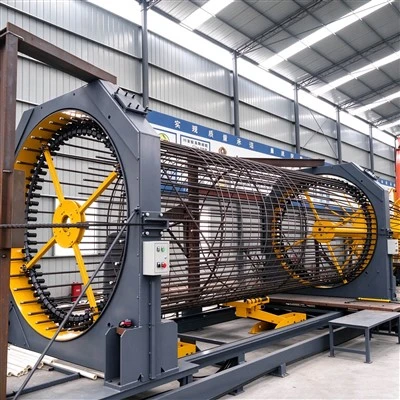
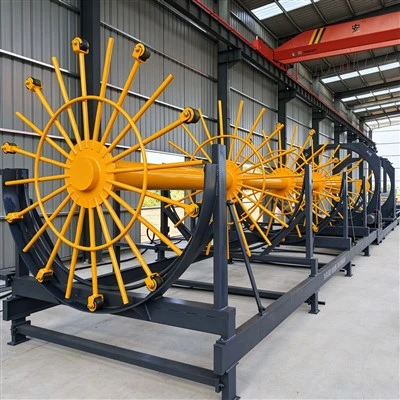
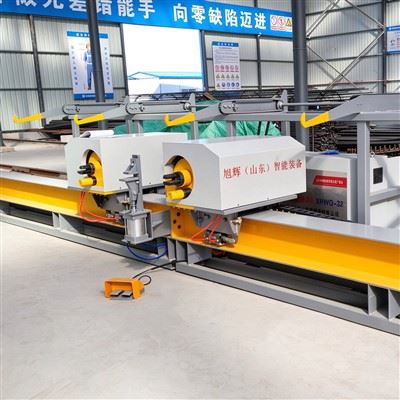
The CNC steel cage welding workstation is an intelligent and automated production unit used for the prefabrication of pile foundation steel cages. The equipment integrates servo feeding, automatic hoop winding, robot welding, and a CNC control system, enabling the one-time completion of positioning, forming, and welding operations for the main bars and hoops. It is widely used in bridge, subway, water conservancy, and high-rise building foundation projects.
The conventional steel cage rolling welder completes the formation of the steel cage through the rotation of rollers and uses two methods: resistance spot welding and gas protection welding. The loading and positioning steps require manual assistance.
The core differences between the two mainly include the following five points:
First, the welding method. The welding workstation uses robot gas protection welding, supporting梅花 welding and full welding, meeting the standards of high-quality projects; while the rolling welders are mostly fixed spot welding.
Second, the forming accuracy. Fully servo synchronous control ensures stable spacing of hoops and concentricity of the steel cage, making it less prone to distortion when processing long cages.
Third, the degree of automation. The workstation can automatically load and unload materials, and the process formula can be stored in one click, making it easier to change specifications and debug; the rolling welders need frequent manual parameter adjustments.
Fourth, the stability of the finished product. Robot welding significantly reduces false welding and weld-through defects, making it easier to pass the supervision acceptance.
Fifth, the expansion of production capacity. The CNC steel cage welding workstation operates on a continuous production line, with multiple guns welding simultaneously, and the effective output per shift is 50% to 100% higher than that of the conventional rolling welder; changing specifications and debugging are faster, with fewer reworkings, supporting long-term uninterrupted stable production, and enabling easy handling of large orders, helping steel processing plants expand production quickly and meet deadlines. The conventional rolling welder is limited by manual assistance and welding rhythm, with a lower output limit, and large orders are prone to delay in progress.
For steel processing plants with high quality requirements and large-scale production, the CNC welding workstation has stable, efficient production capacity and lower manpower requirements; the rolling welder is more suitable for projects with limited budgets and relatively loose welding standards.