

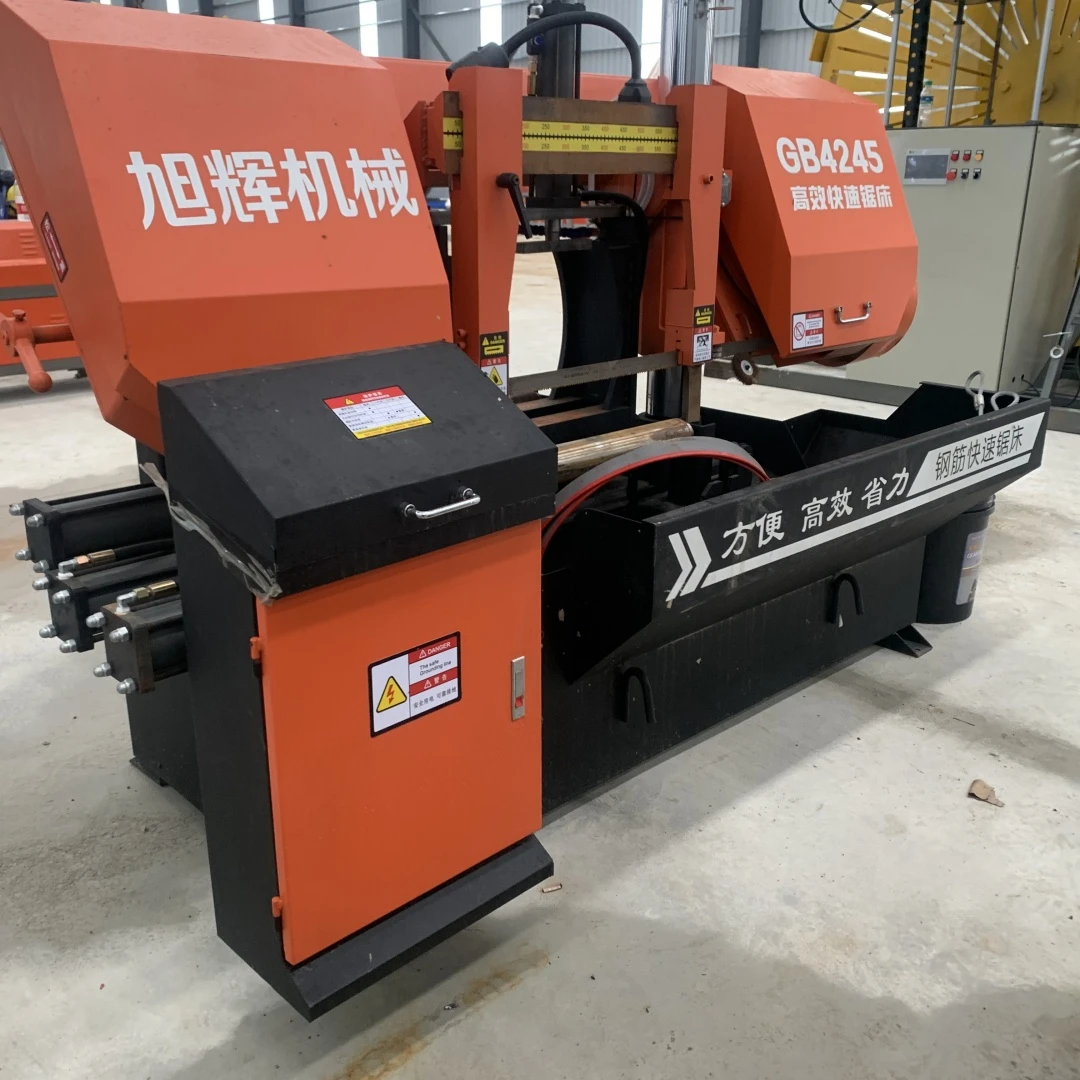
The steel bar sawing machine is specialized equipment dedicated to cutting and processing metal materials such as steel bars, round steel, and square steel. Its core function is to precisely cut materials through the sawing device, and it is widely used in fields such as construction, machinery, and transportation.
ompared with ordinary cutting equipment, it has three core advantages. First, it offers high cutting accuracy, with smooth cuts and no burrs. Dimensional error can be controlled within the millimeter range, meeting the strict requirements of engineering structures for reinforcing bar sizes. Second, it provides high processing efficiency, enabling continuous cutting of entire bundles of steel bars and significantly reducing manual operation time. Third, material loss is low and the saw seam width is narrow (usually only 1–2 mm), minimizing steel waste and aligning with the concept of green production.
From the perspective of equipment composition, a steel bar sawing machine is mainly composed of five core components:
Bed structure – provides stable support and withstands impact forces during cutting.
Sawing system – includes saw blades and saw frame, achieving cutting through reciprocating or rotational motion.
Hydraulic system – controls the lifting of the saw frame and the clamping of the workpiece to ensure smooth operation.
Electrical control system – adjusts cutting speed and feed rate to achieve automated operation.
Cooling and lubrication system – reduces the saw blade temperature to extend service life and improve cut quality.
The five major components work in coordination to ensure the stable and efficient operation of the equipment.
Key Technical Points: Core Indicators Affecting Equipment Performance
To assess the performance of a steel bar sawing machine, four key technical indicators must be considered. These indicators directly determine the applicable scenarios and processing results of the equipment:
Cutting accuracy
The main criteria are dimensional error and cut flatness, influenced by the quality of the saw blade, equipment rigidity, and feed rate control. High-quality CNC sawing machines can achieve a dimensional error of ±0.5 mm, with cut verticality deviation ≤0.1 mm/m, meeting strict requirements in engineering scenarios such as bridges and high-speed railways.
Cutting efficiency
Usually measured by "the number of steel bars cut per unit time or weight," it is closely related to saw blade linear speed, feed rate, and the degree of equipment automation. For example, with HRB400 steel bars of 20 mm diameter, a fully automatic model can cut 80–120 bars per hour, while a manual model can cut only 20–30 bars. In addition, the whole-bundle cutting function is also key to improving efficiency.
Equipment stability and lifespan
This depends on the bed material, saw blade material, and the lubrication and cooling system. Generally, the trouble-free operating time of high-quality steel bar sawing machines can exceed 8,000 hours.
Level of automation and intelligence
Modern steel bar sawing machines are gradually upgrading to "intelligent equipment," mainly reflected in three functions. First, parametric programming eliminates repeated debugging, allowing batch cutting to be completed with a single click. Second, condition monitoring uses sensors to track data such as saw blade wear and hydraulic pressure in real time, with automatic alarms for abnormalities. Third, networking and collaboration enable connection to the factory MES system, synchronizing production plans and processing data in real time to support automated production lines.
Core Application Scenarios: Meeting Essential Processing Needs Across Multiple Fields
As basic processing equipment, the steel bar sawing machine is applied in multiple key industries and is an indispensable link in the industrial chain.
Construction engineering
This is the largest application scenario, handling the pre-treatment of steel bars in projects such as bridges, high-rise buildings, and subway tunnels. In bridge construction, steel bars must be cut to specific lengths before being welded into cages. The high precision of the sawing machine ensures the structural stability of these cages.
Mechanical manufacturing
The cutting of raw materials for mechanical parts, such as round steel and square steel used in machine tool bases and motor housings, requires high cutting precision and no deformation to avoid errors in subsequent processing.
Transportation and energy
In transportation construction, the processing of steel bars for highway guardrails and railway fasteners relies on sawing machines. In the energy sector, the steel structures of wind power towers and photovoltaic brackets require cutting large-diameter and thick-walled reinforcing bars, placing higher demands on cutting capacity and stability.