

Hey there! As a supplier of intelligent welding robots, I've seen firsthand the challenges that come with making these robots adaptable to different production lines. In this blog, I'll share some tips and strategies on how to enhance the adaptability of intelligent welding robots, so they can work efficiently across various production setups.
Understanding the Challenges
Before we dive into the solutions, let's first understand the challenges that make it difficult for intelligent welding robots to adapt to different production lines. One of the main issues is the variability in workpiece dimensions, shapes, and materials. Each production line may have its own unique requirements, and the robot needs to be able to handle these differences without compromising on quality or efficiency.
Another challenge is the integration of the robot with other equipment on the production line. The robot needs to work seamlessly with conveyors, fixtures, and other machinery to ensure a smooth workflow. Any misalignment or compatibility issues can lead to delays and errors in the welding process.
Strategies for Enhancing Adaptability
1. Flexible Programming and Teach Pendant
One of the key ways to enhance the adaptability of intelligent welding robots is through flexible programming. Modern robots come with advanced programming interfaces that allow operators to easily teach the robot new tasks and adapt to different production requirements. The teach pendant, a handheld device used to control the robot, plays a crucial role in this process.
By using the teach pendant, operators can manually guide the robot through the welding path, adjusting the speed, position, and other parameters as needed. This allows for quick and easy programming of different welding tasks, making it possible to switch between production lines without significant downtime.
2. Vision Systems and Sensors
Vision systems and sensors are essential for enabling intelligent welding robots to adapt to different workpieces and production environments. These technologies allow the robot to detect the position, shape, and orientation of the workpiece, as well as monitor the welding process in real-time.
For example, a vision system can be used to identify the edges and contours of the workpiece, allowing the robot to adjust its welding path accordingly. Sensors can also be used to measure the temperature, pressure, and other parameters during the welding process, ensuring that the quality of the weld is consistent.
3. Modular Design
A modular design is another effective strategy for enhancing the adaptability of intelligent welding robots. By using modular components, the robot can be easily customized and reconfigured to meet the specific requirements of different production lines.
For example, the robot's arm can be designed with interchangeable end-effectors, allowing it to perform different welding tasks such as spot welding, arc welding, or laser welding. The modular design also makes it easier to replace or upgrade components as needed, reducing maintenance costs and downtime.

4. Integration with Production Line Management Systems
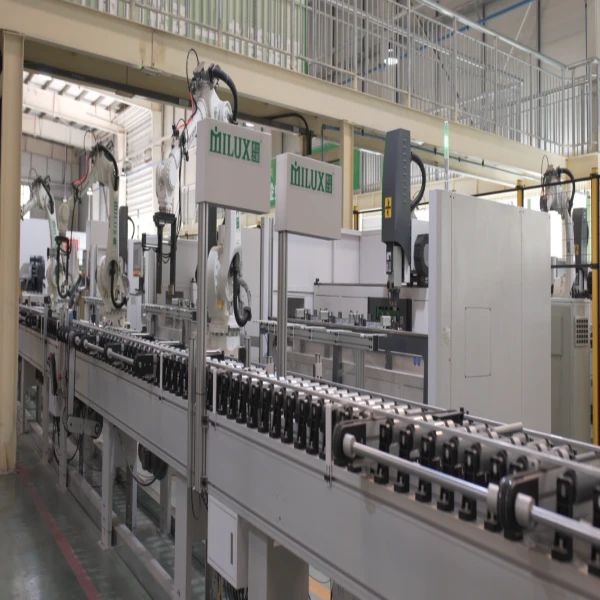
Integrating the intelligent welding robot with the production line management system is crucial for ensuring a seamless workflow. By connecting the robot to the system, operators can monitor and control the robot's performance in real-time, as well as receive alerts and notifications in case of any issues.
The production line management system can also be used to schedule and optimize the welding tasks, ensuring that the robot is used efficiently and effectively. This integration allows for better coordination between the robot and other equipment on the production line, reducing the risk of errors and delays.
The Role of Training and Support
In addition to the technical solutions mentioned above, training and support are also essential for enhancing the adaptability of intelligent welding robots. Operators need to be trained on how to program and operate the robot, as well as how to troubleshoot any issues that may arise.
As a supplier, we offer comprehensive training programs for our customers, including on-site training and online resources. Our technical support team is also available 24/7 to provide assistance and guidance whenever needed.
Real-World Examples
To illustrate the effectiveness of these strategies, let's take a look at some real-world examples of how intelligent welding robots have been used to enhance adaptability in different production lines.
Example 1: Automotive Manufacturing
In the automotive industry, intelligent welding robots are used to weld various components of the car body, such as the frame, doors, and hood. These robots need to be able to adapt to different car models and production volumes, as well as work in a high-speed and high-precision environment.
By using flexible programming, vision systems, and modular design, automotive manufacturers have been able to achieve significant improvements in productivity and quality. For example, New Type Of Intelligent Welding Robot has been specifically designed for automotive applications, offering high-speed and high-precision welding capabilities.
Example 2: Aerospace Manufacturing
In the aerospace industry, intelligent welding robots are used to weld critical components such as engine parts and fuselage sections. These components require a high level of precision and quality, as well as the ability to work with different materials such as titanium and aluminum.
By using advanced vision systems and sensors, aerospace manufacturers have been able to ensure the accuracy and consistency of the welding process. For example, Intelligent Welding Robot Production Line offers a complete solution for aerospace welding, including robot programming, vision systems, and quality control.
Example 3: General Manufacturing
In general manufacturing, intelligent welding robots are used to weld a wide range of products, from small components to large structures. These robots need to be able to adapt to different production requirements, such as different welding processes, materials, and workpiece sizes.
By using modular design and flexible programming, general manufacturers have been able to achieve greater flexibility and efficiency in their production lines. For example, Intelligent Handling Robot can be used to handle and position the workpiece, allowing the welding robot to focus on the welding process.
Conclusion
Enhancing the adaptability of intelligent welding robots is crucial for ensuring their effectiveness and efficiency in different production lines. By using flexible programming, vision systems, modular design, and integration with production line management systems, we can make these robots more versatile and adaptable to a wide range of production requirements.
As a supplier of intelligent welding robots, we are committed to providing our customers with the latest technologies and solutions to help them improve their productivity and quality. If you're interested in learning more about our products and services, or if you have any questions or concerns, please don't hesitate to contact us. We look forward to working with you!
References
- Robotics and Automation Handbook, Second Edition, edited by Thomas R. Kurfess
- Welding Handbook, Volume 1: Welding Science and Technology, American Welding Society
- Industrial Robotics: Theory, Modelling and Control, by Bruno Siciliano and Oussama Khatib