

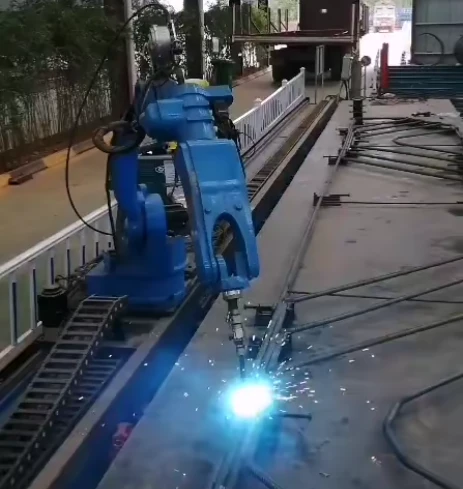
Electromagnetic compatibility (EMC) is a crucial aspect in the operation of intelligent welding robots. As a leading supplier of intelligent welding robots, we understand the significance of EMC and its impact on the performance, reliability, and safety of these advanced machines.

Understanding Electromagnetic Compatibility
Electromagnetic compatibility refers to the ability of an electrical or electronic device to function properly in its electromagnetic environment without causing intolerable electromagnetic interference (EMI) to other devices in the same environment. In the context of intelligent welding robots, this means that the robot should be able to carry out its welding tasks efficiently while not being affected by external electromagnetic fields and also not generating excessive electromagnetic disturbances that could disrupt the operation of other nearby equipment.
EMC is divided into two main aspects: electromagnetic interference (EMI) and electromagnetic susceptibility (EMS). EMI is the generation of electromagnetic noise by the device, which can affect other nearby devices. For example, in a factory setting, an intelligent welding robot that generates high - frequency electromagnetic noise may interfere with the operation of control systems, sensors, or communication devices. EMS, on the other hand, is the device's ability to withstand external electromagnetic disturbances without malfunctioning. In an industrial environment, there are various sources of electromagnetic fields, such as power lines, radio frequency transmitters, and other electrical equipment. An intelligent welding robot needs to be immune to these external fields to ensure consistent and accurate welding performance.
Why is EMC Important for Intelligent Welding Robots?
Performance and Precision
Intelligent welding robots rely on precise control systems and sensors to perform welding operations. These systems are sensitive to electromagnetic interference. Any interference can cause errors in the control signals, leading to inaccurate welding paths, inconsistent weld quality, and even robot malfunctions. For example, a small deviation in the position control signal due to EMI can result in a misaligned weld, which could compromise the structural integrity of the welded product. By ensuring good EMC, we can guarantee that the robot can maintain high - performance levels and produce high - quality welds consistently.
Safety
Safety is of utmost importance in industrial environments. An intelligent welding robot that is affected by electromagnetic interference may behave unpredictably. For instance, it could suddenly change its movement trajectory, which poses a significant risk to operators and other equipment in the vicinity. Moreover, if the robot's safety control systems are disrupted by EMI, emergency stop functions may fail to work properly, increasing the potential for accidents. EMC measures help to ensure that the robot's safety features work as intended, protecting both the operators and the surrounding environment.
System Integration
In modern industrial production lines, intelligent welding robots are often integrated with other automated equipment and control systems. For example, they may be connected to conveyor belts, material handling systems, and quality inspection equipment. Good EMC is essential for seamless system integration. If a welding robot generates excessive electromagnetic noise, it can interfere with the communication and operation of other connected devices, causing the entire production line to malfunction. By achieving high - level EMC, we can ensure that the intelligent welding robot can work harmoniously with other equipment, improving overall production efficiency.
EMC Challenges in Intelligent Welding Robots
High - Power Welding Processes
Intelligent welding robots typically use high - power welding processes such as arc welding. These processes involve high - current and high - voltage electrical discharges, which generate strong electromagnetic fields. The high - frequency components of these fields can spread over a wide frequency range, making it difficult to control and suppress EMI. For example, the arc in arc welding can produce electromagnetic radiation in the radio frequency range, which can interfere with nearby wireless communication systems and electronic devices.
Complex Electronic Systems
Intelligent welding robots are equipped with a variety of complex electronic systems, including control boards, sensors, and communication modules. These systems are sensitive to electromagnetic interference. The close proximity of different electronic components within the robot can also lead to internal EMI problems, such as cross - talk between circuits. Additionally, the communication interfaces, such as Ethernet and wireless connections, are vulnerable to external electromagnetic disturbances, which can cause data transmission errors and system malfunctions.
Our Solutions for EMC in Intelligent Welding Robots
As a supplier of intelligent welding robots, we have taken several measures to address EMC challenges and ensure the electromagnetic compatibility of our products.
Design Optimization
We focus on optimizing the electrical and mechanical design of our intelligent welding robots. For the electrical design, we use shielding techniques to reduce the emission of electromagnetic radiation. For example, we enclose sensitive electronic components in metal shields that can block electromagnetic fields. We also carefully layout the printed circuit boards (PCBs) to minimize the coupling of electromagnetic interference between different circuits. In terms of mechanical design, we ensure proper grounding of the robot's structure to provide a low - impedance path for the flow of electromagnetic noise, reducing the risk of EMI.
Component Selection
We select high - quality electronic components with good EMC performance. For example, we use filters and ferrite beads to suppress high - frequency noise in the power supply and signal lines. These components can effectively reduce the transmission of electromagnetic interference within the robot. We also choose communication modules that have built - in EMC protection features, ensuring reliable data transmission in the presence of electromagnetic disturbances.
Testing and Certification
Before our intelligent welding robots are released to the market, they undergo rigorous EMC testing. We test the robots in an anechoic chamber, which is a specialized environment designed to simulate different electromagnetic conditions. The tests include measuring the emission of electromagnetic radiation and the robot's susceptibility to external electromagnetic fields. Only after the robots pass all the EMC tests and obtain relevant certifications can they be sold. This ensures that our products meet international EMC standards and can operate safely and reliably in various industrial environments.
Our Product Range
We offer a wide range of intelligent welding robots to meet different customer needs. Our Automatic Welding Robot For Cover Beam Frame is specifically designed for welding cover beam frames, providing high - precision and efficient welding solutions. The Intelligent Welding Robot Production Line is a comprehensive solution that integrates multiple welding robots and other automated equipment, enabling large - scale and continuous welding production. Our Intelligent Industrial Robot Automation Equipment is suitable for various industrial applications, offering high flexibility and adaptability.
Contact Us for Procurement and Negotiation
If you are interested in our intelligent welding robots and want to learn more about their electromagnetic compatibility and other features, or if you have specific requirements for your welding production, please feel free to contact us. Our professional sales team is ready to provide you with detailed product information and customized solutions. We look forward to establishing long - term cooperation with you and helping you improve your welding production efficiency and quality.
References
- Grover, R. (2007). Electromagnetic Compatibility Engineering. Wiley - Interscience.
- Ott, H. W. (2018). Noise Reduction Techniques in Electronic Systems. Wiley.
- International Electrotechnical Commission (IEC). (2019). Electromagnetic compatibility (EMC) - Part 1 - 2: General - Immunity requirements for industrial environments.