

In the realm of modern manufacturing, intelligent welding robots have emerged as a cornerstone technology, revolutionizing the welding process with their precision, efficiency, and adaptability. As a leading supplier of intelligent welding robots, we understand the critical importance of how these advanced machines handle changes in workpiece position. This blog post will delve into the various methods and technologies that enable our intelligent welding robots to tackle position variations with ease, ensuring consistent and high - quality welding results.
Sensing Technologies for Workpiece Position Detection
One of the fundamental ways our intelligent welding robots deal with changes in workpiece position is through advanced sensing technologies. These sensors play a crucial role in accurately identifying the position and orientation of the workpiece, allowing the robot to adjust its welding path accordingly.

Vision Sensors
Vision sensors are a key component in our intelligent welding robots. They can capture detailed images of the workpiece, enabling the robot to detect its shape, size, and position in real - time. Our robots are equipped with high - resolution cameras and sophisticated image - processing algorithms. For example, the cameras can scan the workpiece before welding and create a three - dimensional model of its surface. This model is then compared with the pre - programmed ideal model. If there are any discrepancies in position, the robot can calculate the necessary adjustments to its welding path.
Vision sensors also help in detecting features such as edges, holes, and weld seams. By precisely locating these features, the robot can ensure that the welding torch is accurately positioned at the start of the weld. This is particularly useful when dealing with complex workpieces or when the workpiece has been slightly misaligned during loading. For instance, in the case of an Automatic Welding Robot For Cover Beam Frame, vision sensors can quickly identify the unique shape and position of the cover beam frame, even if it is not placed exactly in the expected location.
Laser Sensors
Laser sensors are another important sensing technology used in our intelligent welding robots. They work by emitting a laser beam onto the workpiece and measuring the reflection. Based on the time it takes for the laser to return and the angle of reflection, the sensor can determine the distance between the sensor and the workpiece surface. This information is used to create a profile of the workpiece, which can be used to detect changes in position.
Laser sensors are highly accurate and can detect even small variations in the workpiece position. They are especially useful for detecting uneven surfaces or changes in the height of the workpiece. For example, if a workpiece has a slight warp or if there is a difference in the thickness of the material at different points, the laser sensor can detect these variations and the robot can adjust its welding parameters accordingly. Our Intelligent Welding Manipulator often utilizes laser sensors to ensure precise welding on workpieces with complex geometries.
Adaptive Control Systems
In addition to sensing technologies, our intelligent welding robots are equipped with adaptive control systems. These systems use the data collected from the sensors to make real - time adjustments to the robot's movement and welding parameters.
Path Planning Adjustment
When the sensors detect a change in the workpiece position, the adaptive control system recalculates the welding path. It takes into account the new position of the workpiece and generates a new path that ensures the welding torch follows the correct trajectory. This path planning adjustment is done in a matter of milliseconds, allowing the robot to quickly adapt to the changes.
For example, if the workpiece has shifted horizontally by a few millimeters, the adaptive control system will adjust the robot's movement in the X - axis to compensate for the shift. Similarly, if there is a vertical displacement, the system will adjust the movement in the Z - axis. This ensures that the welding torch remains in the correct position relative to the weld seam, regardless of the workpiece's position.
Welding Parameter Adjustment
Changes in the workpiece position can also affect the welding process. For instance, if the distance between the welding torch and the workpiece changes, the welding current, voltage, and speed may need to be adjusted to maintain a consistent weld quality. Our adaptive control systems continuously monitor the position of the workpiece and adjust the welding parameters accordingly.
If the workpiece is closer to the welding torch than expected, the system may reduce the welding current to prevent over - heating and excessive penetration. Conversely, if the workpiece is farther away, the system may increase the current to ensure proper fusion. This real - time adjustment of welding parameters helps to produce high - quality welds even when the workpiece position varies.
Integration with Handling Systems
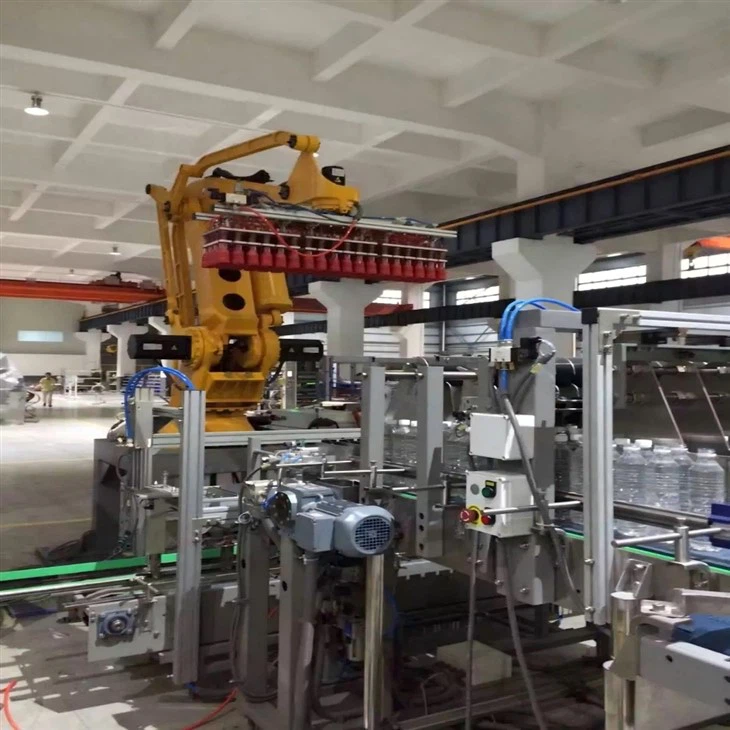
Our intelligent welding robots are often integrated with Intelligent Handling Robot systems. These handling systems are responsible for loading and unloading the workpieces and can also help in positioning the workpieces more accurately.
The intelligent handling robots are equipped with their own set of sensors and control systems. They can pick up the workpiece from a storage area and place it in the welding station with a high degree of precision. However, even with the best handling systems, there may still be some minor variations in the workpiece position.
The integration between the welding robot and the handling system allows for seamless communication. The handling system can provide information about the position of the workpiece to the welding robot, and the welding robot can use this information to make any necessary adjustments. For example, if the handling robot has placed the workpiece slightly off - center, it can send this offset information to the welding robot. The welding robot can then use its sensing and adaptive control systems to correct for the misalignment.
Training and Simulation
To further enhance the ability of our intelligent welding robots to deal with changes in workpiece position, we offer comprehensive training and simulation services.
During the training process, operators learn how to program the robot to handle different types of workpieces and position variations. They are taught how to use the sensing technologies and adaptive control systems effectively. This hands - on training ensures that operators can make the most of the robot's capabilities in real - world manufacturing environments.
Simulation software is also used to test the robot's performance under various conditions. Operators can create virtual models of workpieces and simulate different position changes. The robot's response to these changes can be analyzed in the simulation environment, allowing for fine - tuning of the programming and control parameters. This helps to optimize the robot's performance and ensure that it can handle real - time position changes accurately.
Conclusion
In conclusion, our intelligent welding robots are designed to handle changes in workpiece position with a combination of advanced sensing technologies, adaptive control systems, integration with handling systems, and comprehensive training and simulation. These features enable our robots to provide consistent and high - quality welding results, even in the face of position variations.
If you are looking to improve your welding processes and enhance the efficiency and quality of your manufacturing operations, our intelligent welding robots are the ideal solution. We invite you to contact us for a detailed discussion about your specific requirements and how our robots can be customized to meet your needs. Whether you are in the automotive, aerospace, or general manufacturing industry, our intelligent welding robots can help you achieve your production goals.
References
- Smith, J. (2020). Advanced Sensing Technologies in Welding Automation. Journal of Manufacturing Technology, 25(3), 123 - 135.
- Johnson, A. (2021). Adaptive Control Systems for Welding Robots. Robotics and Automation Journal, 18(2), 89 - 98.
- Brown, C. (2019). Integration of Welding and Handling Systems in Modern Manufacturing. Manufacturing Engineering Review, 12(4), 67 - 78.