

Hey there! As a supplier of intelligent welding robots, I've been diving deep into how these cool machines communicate with other equipment on the production line. It's a super interesting topic, and I'm stoked to share what I've learned with you.
First off, let's talk about why communication between an intelligent welding robot and other equipment is so important. In a production line, every piece of equipment has its own job to do. For an intelligent welding robot, it needs to know when to start and stop welding, what kind of welding parameters to use, and how to coordinate with other machines like conveyors, handling robots, and inspection systems. Without proper communication, the whole production process can get messed up, leading to lower quality products, longer production times, and higher costs.
There are several ways an intelligent welding robot can communicate with other equipment in the production line. One of the most common methods is through industrial Ethernet. Industrial Ethernet is a type of network that's designed specifically for industrial applications. It's fast, reliable, and can handle a large amount of data. With industrial Ethernet, the welding robot can send and receive information to and from other equipment in real - time. For example, it can receive instructions from a control system about the welding tasks, and send back data about its status, such as the temperature of the welding torch, the amount of wire used, and the quality of the weld.
Another way is through fieldbus systems. Fieldbus is a digital communication system that connects sensors, actuators, and other devices on the production line. It's a cost - effective way to communicate between different pieces of equipment. For an intelligent welding robot, a fieldbus system can be used to control its basic functions, like starting and stopping the welding process, adjusting the welding speed, and changing the welding current. There are different types of fieldbus systems, such as Profibus, CANopen, and DeviceNet, and the choice depends on the specific requirements of the production line.
Wireless communication is also becoming more and more popular in industrial settings. With wireless technology, the welding robot can communicate with other equipment without the need for cables. This makes it easier to install and move the robot around the production line. For example, a wireless sensor can be used to detect the position of a workpiece, and send this information to the welding robot. The robot can then adjust its position and orientation accordingly. Wireless communication also allows for more flexibility in the layout of the production line, as there's no need to worry about cable management.
Now, let's take a closer look at how the intelligent welding robot communicates with some specific types of equipment in the production line.
Let's start with the conveyor system. The conveyor is responsible for moving the workpieces to the welding station. The welding robot needs to know when a workpiece has arrived at the correct position so that it can start the welding process. Through communication, the conveyor can send a signal to the welding robot when the workpiece is in place. The welding robot can then start welding and send a signal back to the conveyor when it's finished, so that the conveyor can move the welded workpiece to the next station.
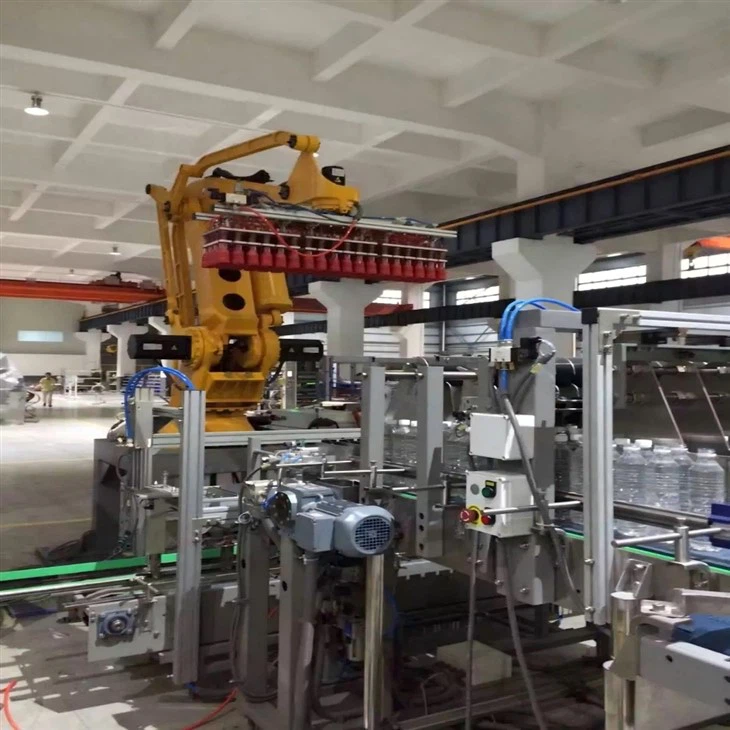
An Intelligent Handling Robot is another important piece of equipment in the production line. It's used to pick up and place the workpieces on the conveyor or in the welding fixture. The intelligent welding robot and the handling robot need to coordinate their actions. For example, the handling robot needs to know when the welding robot has finished welding so that it can pick up the welded workpiece. They can communicate through a common control system or directly with each other using the communication methods we've mentioned earlier.
Inspection systems are also crucial in ensuring the quality of the welded products. After the welding is done, the inspection system checks the quality of the weld. It can detect defects such as cracks, porosity, and incomplete penetration. The inspection system can communicate the inspection results to the welding robot. If there are any defects, the welding robot can be instructed to re - weld the workpiece or adjust its welding parameters for future welds.
The control system is the brain of the production line. It manages all the equipment and ensures that they work together smoothly. The intelligent welding robot communicates with the control system to receive overall instructions about the production process. The control system can set the welding parameters, schedule the welding tasks, and monitor the performance of the robot. It can also receive feedback from the robot and make adjustments as needed.
As a supplier of Intelligent Industrial Robot Automation Equipment, I've seen firsthand how important it is for the intelligent welding robot to communicate effectively with other equipment in the production line. A well - coordinated production line can significantly improve the efficiency and quality of the manufacturing process.
If you're thinking about setting up an Intelligent Welding Robot Production Line, or upgrading your existing one, it's essential to consider the communication aspects. We can help you choose the right communication methods and technologies for your specific needs. Whether you need a high - speed industrial Ethernet network for a large - scale production line, or a cost - effective fieldbus system for a small - to - medium - sized operation, we've got you covered.
We understand that every production line is unique, and we're committed to providing customized solutions. Our team of experts can work with you to design a communication system that integrates seamlessly with your existing equipment and meets your production goals.
If you're interested in learning more about our intelligent welding robots and how they can communicate with other equipment in your production line, don't hesitate to reach out. We're here to answer all your questions and guide you through the process of purchasing and implementing the right automation solutions for your business. Let's work together to take your production line to the next level!

References
- "Industrial Communication Technology Handbook" by Peter Harms, Thomas L. Schlegel, and Arun K. Somani
- "Automation, Production Systems, and Computer - Integrated Manufacturing" by Mikell P. Groover