Working Principle
Steel bar pretreatment
Before entering the welding process, steel bars must first undergo straightening and cutting. The workstation is equipped with a high-precision steel bar straightening machine. By passing the bars through multiple sets of straightening rollers, bent steel bars are repeatedly rolled until they meet straightness requirements. The straightened bars are then precisely cut by a CNC cutting machine according to preset lengths, ensuring that length errors remain within a very small range.
Skeleton forming
The assembly of main bars and reinforcing bars is a key step in forming the steel cage framework. Through a dedicated skeleton-forming mechanism, the workstation accurately fixes the cut main ribs on the rotating mold at the required intervals and quantities according to design requirements. At the same time, the reinforcing ribs are automatically conveyed and welded onto the main ribs, forming the basic framework structure of the steel cage.
Ribbed welding
Ribbed welding is one of the core processes of the steel cage welding workstation. After the framework is formed, the winding bars are automatically laid out and wound around it. Meanwhile, the welding equipment quickly and firmly welds the intersection points of the winding bars and the main bars according to the preset parameters. Resistance welding and carbon dioxide gas shielded welding are usually adopted. Both methods ensure stable welding quality and high weld strength.
Equipment Composition
Mechanical part
Steel bar conveying system: Composed of the feeding frame, straightening machine, cutting machine, and conveying track. The feeding frame stores the bars to be processed. The straightening machine straightens them, the cutting machine cuts them to the required length, and the conveying track delivers the processed bars to each station.
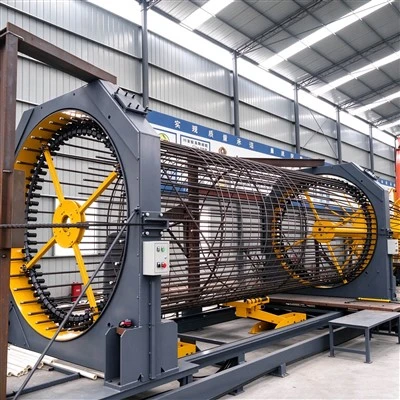
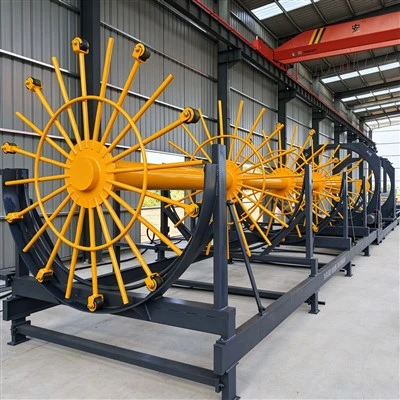
Skeleton forming system: Includes a rotating mold, a main rib fixing device, and a reinforcing rib welding device. The rotating mold drives the cage frame to rotate, facilitating welding around the bars. The fixing device ensures the correct position of the main reinforcement during assembly. The welding device automatically welds the reinforcing ribs to the main ribs.
Ribbed welding system: Mainly consists of a ribbed wire laying frame, a ribbed conveying device, and a welding head. The laying frame supplies the winding bars, the conveying device accurately winds them onto the cage frame, and the welding head welds the intersections of the winding bars and main bars.
Electrical control part
Control system: An advanced programmable logic controller (PLC) serves as the core control unit. By executing dedicated control programs, it automatically controls each process of the workstation. Operators can input parameters such as cage diameter, length, number of main bars, and winding bar spacing through the operation panel. The control system then automatically adjusts the equipment to ensure processing accuracy and product quality.
Drive system: Composed of a motor, reducer, and transmission device, it provides power for each moving part. The motor regulates speed through the reducer, while the transmission device delivers power to the actuators (such as the conveying track, rotating mold, and winding device), ensuring smooth operation.
Advantages and Characteristics
Improved production efficiency
The steel cage welding workstation enables fully automated manufacturing. Compared with traditional manual methods, production efficiency has greatly increased. For example, manual processing typically produces 5–8 sections per day, whereas a welding workstation can produce 20–30 sections per day, improving efficiency by 3–4 times.
Ensured product quality
The workstation uses high-precision mechanical components and advanced control systems, enabling precise processing. For instance, the spacing error of main bars can be controlled within ±3 mm, and the spacing error of winding bars within ±2 mm. Welding quality is stable and reliable, with high weld strength, ensuring consistent product quality. Automation reduces the influence of human factors such as fatigue and skill variation, guaranteeing that each cage meets strict standards.
Reduced labor costs
Traditional steel cage processing requires extensive manual work, including handling, straightening, cutting, and welding, resulting in high labor costs. The welding workstation only requires 1–2 operators for monitoring and maintenance, significantly reducing labor expenses.
Adaptability to diverse demands
The workstation can meet production requirements for steel cages of different specifications through flexible parameter settings and mold adjustments. Whether producing small-diameter cages for small-scale projects or large-diameter cages for bridges and high-rise buildings, equipment parameters can be quickly adjusted to match production needs.

To enhance universality and maintainability, steel cage welding workstations are developing toward integration and modularization. Future systems will adopt modular design, standardizing and integrating functional modules. Users will be able to select modules as needed, enabling rapid installation and commissioning.